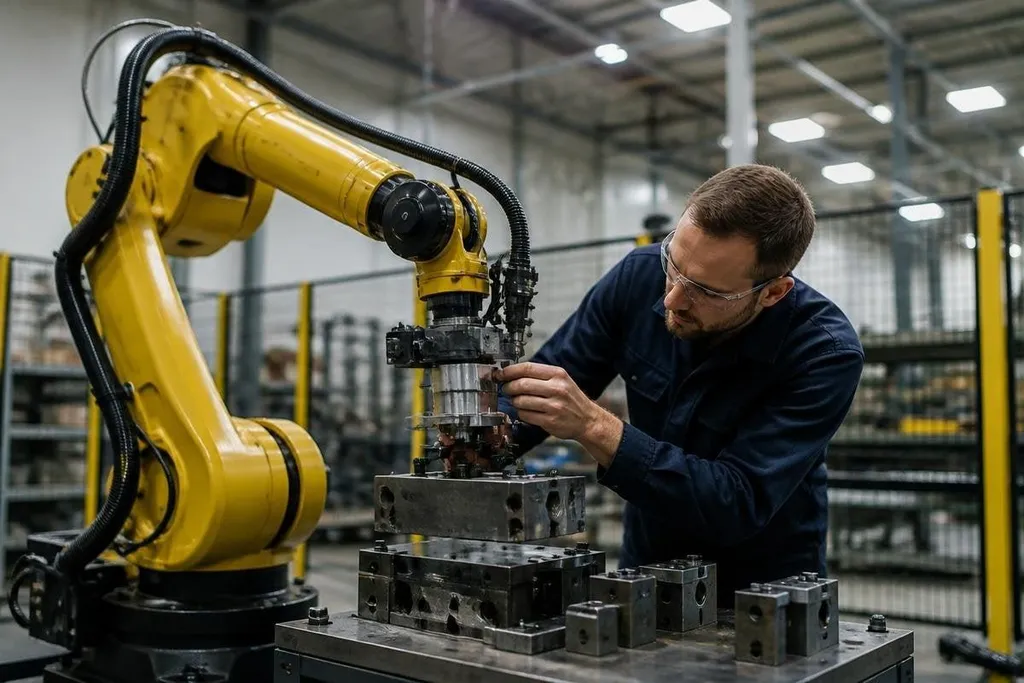
A factory robot may weld, lift, inspect, or load parts, but it still needs a cell, software, service, and people who understand the process. Those needs create business openings for firms that can connect a robot to real production work.
For a small company, the opportunity is rarely in building a complete robot. It is more often in solving one factory problem with the right arm, gripper, sensor, and control system.
Quick read
- Robot integrators can build and install complete work cells for factories.
- Toolmakers can sell grippers, fixtures, feeders, and safety equipment for one task.
- Service firms can earn recurring revenue from training, repairs, software, and cell changes.
Integration turns parts into a working cell
A robot arm on a pallet does not make a factory automated. The arm needs a program, a tool at its wrist, a way to receive parts, and a safe area where people and machines can work together.
That leaves room for system integrators. They study a factory process, choose the robot and end effector, connect the cell to a programmable logic controller, and test the complete sequence. The sale may include the frame, guarding, sensors, wiring, software, and worker training.
This work suits firms with a narrow focus. One integrator might build welding cells for metal shops. Another might handle case packing for food plants. A third could set up machine tending, where a robot loads and unloads a computer numerical control machine.
The business earns money from design and installation first. Later work can come from changes to the cell, new product sizes, software updates, and repair visits.
Small tools can solve expensive problems
Robot makers sell the arm, but the arm does not decide how to hold a part. That job belongs to the gripper and the fixture.
A tool company can build a gripper for a narrow part range, a fixture that keeps parts in the same position, or a feeder that presents parts one at a time. These products may look small beside a robot, yet they decide whether the cycle runs cleanly.
Vision is another opening. A camera can check a part's position, read a code, or spot a missing component. The useful product may be the lighting, image software, mounting system, or service package around that camera.
The best products in this area solve one repeatable task. A company that makes a gripper for thin metal blanks has a clearer sales path than one offering a general tool for every factory.
Software and data keep the cell useful
Production managers need to know when a robot stops, why it stopped, and how many parts it handled before the stop. Software firms can connect the cell to production records and show that information to a supervisor.
That work includes dashboards, fault messages, production counts, and links to maintenance systems.
Offline programming lets a technician test robot paths on a computer before changing the live cell. The challenge is access: many factories have equipment from different makers, with different control systems and data formats.
A software company that can connect those systems without forcing a full factory replacement has a practical reason to get paid.
The business around a factory robot includes software, integration, training, and repairs. Robot24 reports on the named machines and companies behind those services, setting up the next question: which work can continue after the sale?
Service may last longer than the sale
One factory robot can stay in service for years, while the product moving through its cell may change several times. That creates work after installation.
Service firms can inspect joints, replace cables, tune motion, update programs, and train new staff. They can also change a gripper or fixture when a factory adds a new part. For smaller plants, an outside technician may cost less than keeping a full robotics team on staff.
Training is another business. Workers may need to learn robot programming, safety checks, fault recovery, and tool changes. A useful course should end with a task the worker can perform on the plant's own equipment.
A practical screen for a new business
Before building a product or service, check these points:
- Name the task: Can you describe the part, cycle, and operator action in one sentence?
- Count the handoffs: How many times must the robot exchange data or parts with other equipment?
- Set the limit: What payload, reach, speed, or accuracy does the task need?
- Plan service: Who fixes the cell when a sensor, cable, gripper, or program fails?
- Price the result: Can the buyer link your work to more output, fewer defects, or less manual handling?
- Test the change: Can your product handle a new part size without rebuilding the whole cell?
A factory may buy a robot once, but it will keep paying for tools, software, training, and repairs when those services solve a live production problem. I'd focus on one process with a clear owner, a repeatable task, and a service need that continues after installation. The next business may be built around the robot, not inside it.